insights
What Is AI Inventory Planning?
Hannah Astra, Director of Marketing, Moselle

AI inventory planning helps growing brands automate demand forecasting, replenishment, and allocation — so every buy decision is based on current data, not last month's export. Here's how it works.
At its core, it brings together two forecasting methodologies — top-down (starting from revenue targets) and bottom-up (starting from SKU-level data) — and reconciles them automatically. Where traditional planning forces a choice between one or the other, AI handles both and learns from the gaps.
The Problem With Traditional Inventory Planning
For growing consumer brands doing anywhere from a few hundred thousand to several million dollars in revenue, inventory is often the single largest cash commitment in the business. Most manage it the same way they always have: spreadsheets, gut feel, and reports that are stale before anyone acts on them.
Stockouts kill revenue and customer trust
When a product isn't available, the sale doesn't wait. For a brand doing $2M in annual revenue, even a 5% stockout rate represents $100,000 in missed sales — and 69% of those customers buy from a competitor and don't come back.
Inaccurate data leads to bad decisions
Traditional planning relies on data manually entered, exported, and interpreted across disconnected tools. Shopify, spreadsheets, accounting software, and supplier emails rarely speaking to each other. 58% of retail and DTC brands report inventory accuracy below 80% — and bad data compounds with every planning cycle.
Excess stock silently drains cash
Overstocking doesn't feel like a problem until it is — slow movers sitting in a warehouse, carrying costs accumulating, and eventually margin-destroying markdowns to clear the shelf. For a brand holding $500,000 in stock, that's up to $150,000 a year in cost of capital, storage, and obsolescence risk.
There's no early warning system
Spreadsheets don't flag what's about to go wrong. By the time a planner notices a SKU is trending toward a stockout, the reorder window may have already passed. These aren't enterprise problems — they're the everyday reality for growing brands.
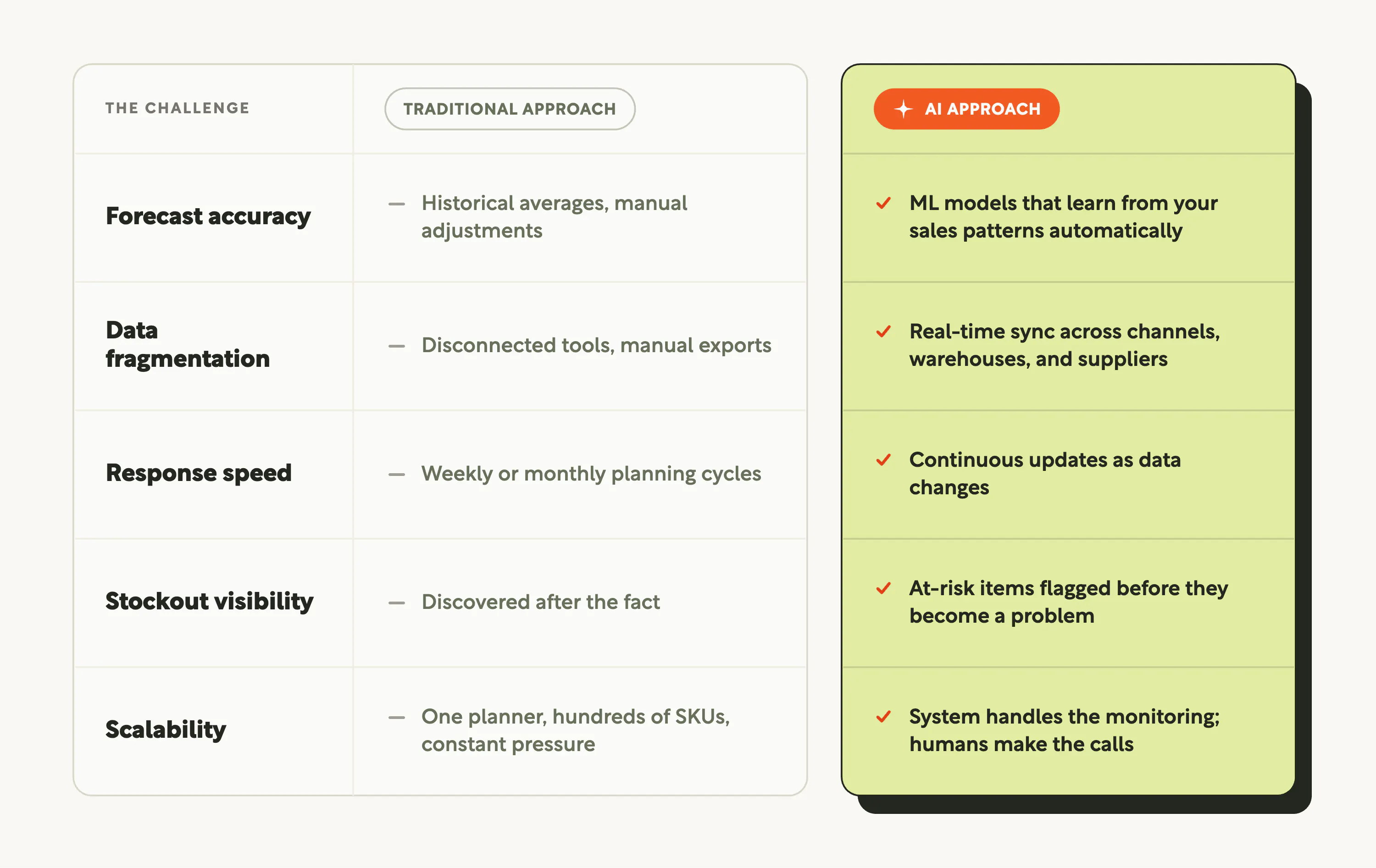
AI inventory planning is designed to fix each of these. Here's how the approaches compare:
How AI Inventory Planning Works
AI inventory planning manages the full inventory lifecycle — from forecasting demand to executing orders to monitoring performance. Here's what each capability actually does:
1. Demand Forecasting
Forecasting is the analytical process of predicting future demand. It's the foundation everything else is built on — and where traditional methods fail most visibly.
Moselle generates forecasts automatically using machine learning, analyzing historical sales patterns, seasonality, and trends across every SKU and channel. Forecasts update on a 12-month rolling basis, and the system tracks accuracy using MAPE (Mean Absolute Percentage Error) — automatically by SKU, channel, and time period.
We support both approaches to forecasting and recommend using them together:
- Bottom-up: Analyses each SKU individually from historical sales data and aggregates upward. Best for brands with rich sales history, seasonal products, or complex catalogs.
- Top-down: Starts from a revenue target and works backward to unit requirements. Best for financial alignment or newer brands building out their planning process.
The most accurate forecasts use both. Build a top-down target, run a bottom-up analysis, compare. Where they diverge, you have a signal: either your targets are unrealistic or a SKU is outperforming and needs re-forecasting.
2. Planning: Replenishment and Allocation
Forecasting tells you what demand looks like. Planning is what you do with it.
In Moselle, planning is made up of two distinct but connected disciplines — replenishment and allocation — both built from the same place: the Production Plan.
Replenishment — What do I need to order, and when?
A replenishment plan takes your forecast and current inventory levels, identifies which SKUs are at risk of stocking out within your coverage period, and recommends order quantities and timing. It accounts for supplier lead times, safety stock buffers, and MOQs — and feeds directly into purchase order generation.
Allocation — How do I distribute what I have across my locations?
An allocation plan takes available or inbound inventory and determines how to split it across warehouses, stores, or fulfillment locations based on where demand is strongest — rather than dividing manually by gut feel. This prevents over-allocating to one channel while another runs short.
Both plan types are generated from the same Production Plan in Moselle and can run simultaneously. Many teams maintain a replenishment plan for purchasing decisions and an allocation plan for distribution decisions at the same time.
Mo analyses plans as they're built, flags anomalies, and makes recommendations. The planner stays in control; Mo handles the analysis.
3. Scenario Planning
Growing brands rarely operate in stable conditions. A new product launch, a BFCM promotion, a supplier delay, or a new sales channel all change the inventory picture — often before there's any data to work from.
Moselle supports scenario planning directly within Moselle, letting planners test assumptions and model different outcomes before committing.
Teams use it to build conservative, moderate, and aggressive lift assumptions; model the downstream impact of a supplier delay; or stress-test what a new channel launch means for warehouse allocation. Mo helps to produce the analysis; the operator decides what to action.
4. Continuous Monitoring with Mo
Mo monitors inventory operations continuously — flagging upcoming stockouts, excess inventory building up, forecast accuracy issues, and anomalies in demand patterns.
Underneath that, the forecasting model doesn't sit still either.
Every week, Mo pulls your latest sales, re-fits the model against your updated history, and promotes the new version to production automatically — no one has to notice a forecast has gone stale or trigger a re-run. Each planning decision, promotion, and stockout event trains the model on what's specific to your business, and it shows up in the numbers: brands running weekly reforecasting have seen forecast accuracy improve by 50%+ within a few months.
Who Benefits Most From AI Inventory Planning?

No two brands' demand looks the same — a steady, predictable seller doesn't forecast like a product riding a viral spike, and neither forecasts like a launch with no sales history yet. Moselle fits the model to whichever shape your demand takes, rather than asking you to force your data into one methodology. Here's what that looks like across brand types:
Consumer Brands
Consumer brands managing $500K–$5M in inventory at any given time feel the impact of a bad production buy or a missed reorder across cash flow, fulfilment, and the next season's planning budget. A single misjudged buy on a new colourway or a delayed reorder on a bestseller can set the quarter back in ways that take months to unwind.
AI gives brand teams the ability to plan buys with confidence, surface at-risk items early, and minimise the markdowns and write-offs that erode margin at end-of-season. For new product launches — where there's no historical data — Moselle uses analog-based estimation against comparable SKUs.
DTC and E-Commerce Brands
DTC brands live and die by fulfilment. A stockout isn't just a missed sale — it's a customer who leaves your store and converts at a competitor's, often without coming back. And inventory accuracy below 80% — which 58% of retail and DTC brands report — means every reorder decision is built on compromised data before planning even starts.
Most teams run Moselle alongside their existing spreadsheet process for the first few weeks — validating that the recommendations align with their expectations before fully transitioning. It's a low-risk way to build confidence in the system before depending on it.
Moselle connects to Shopify, Amazon, and Walmart out of the box. Most brands are operational within 5 days. The full structured onboarding completes in 4–5 weeks, without IT involvement for most brands.
CPG Companies
CPG companies face the double challenge of short product shelf life and high promotional complexity. A promotion spike left in the baseline skews every forecast that follows. A price change mid-year makes year-over-year comparisons meaningless without adjustment.
Mo analyses the data with those nuances in mind — a planner can instruct Mo to remove a one-time BOGO spike from the baseline, apply a post-price-change velocity to forward projections, or model how a trade promotion at a key retailer affects replenishment timing. The recommendations are reviewed and applied by the team.
How to Evaluate AI Inventory Planning Solutions
Moselle is built for brands that don't have a six-figure budget for supply chain software or a data science team to run it. Here's what to look for — and how Moselle addresses each criterion.
- Forecasting methodology. Both bottom-up (SKU-level, aggregated upward) and top-down (revenue target, worked backward to units), with automatic reconciliation and MAPE tracked per SKU and channel.
- Data integration. Native, real-time connections to Shopify, Amazon, your 3PL, and financial tools. Moselle connects to 100+ platforms including Shopify, Amazon, Walmart, QuickBooks, Xero, ShipBob, ShipHero, and Fulfil.
- Planning coverage. Both replenishment and allocation in one system, built from the same forecast.
- Order generation. Replenishment plans that flow directly into purchase orders — not reports you rebuild manually.
- Onboarding speed. Operational in 5 days; full onboarding in 4–5 weeks, no IT required.
- Transparency. Every recommendation includes visible reasoning your team verifies before applying.
- Support. Dedicated CSM through onboarding, recurring calls, and quarterly business reviews.
Stop planning on guesswork.
Growing brands doing hundreds of thousands to several million in revenue can't afford a bad buy decision or a missed reorder. Moselle gives you top-down and bottom-up inventory plans built from your actual data — and Mo surfaces exactly what needs attention before it becomes a problem.
Frequently Asked Questions
- What is the difference between top-down and bottom-up inventory planning?
Top-down inventory planning starts with a revenue target and works backward to unit requirements. Bottom-up inventory planning starts with SKU-level sales data and aggregates upward. The most accurate forecasts use both. Read the full guide → - What is the difference between a replenishment plan and an allocation plan?
A replenishment plan answers: what do I need to order, and when? It identifies at-risk SKUs and generates order recommendations based on your forecast, lead times, and safety stock. An allocation plan answers: how do I distribute what I already have? It splits available inventory across warehouses, stores, or channels based on where demand is strongest. Learn how planning works in Moselle → - How long does it take to implement AI inventory planning software?
Most Moselle customers are operational within 5 days of connecting their data. The full structured onboarding — integrations, first forecast, production planning, and sign-off — completes in 4–5 weeks. See how brands get started → - Does Moselle integrate with Shopify and Amazon?
Yes — natively and in real time. Moselle connects to Shopify, Amazon, Walmart, and 100+ other platforms including QuickBooks, Xero, ShipBob, ShipHero, and Fulfil. View all integrations →