insights
Moselle vs. ChatGPT and Claude: Why Inventory Planning Needs More Than an LLM
Lakhveer Jajj, Founder & CEO

It starts with a pasted spreadsheet..
The answer looks smart. Then someone asks: which forecast did we use last month? Who approved that reorder? Why are this week's numbers different from last week's?
That's the moment a team realizes a chat window isn't a planning system.
In this guide:
- Why purpose-built planning models beat a general-purpose LLM
- How Moselle keeps AI agents secure, governed and visible
- Why always-on agents cost less than an always-on planner
- How the Moselle MCP brings Moselle into Claude and other AI tools
Why does inventory planning need more than an LLM?
Because planning isn't a question you ask once. It's a process that runs every week, touches real money and has to be right every time. ChatGPT and Claude are excellent generalists. Moselle is a specialist: best-in-class forecasting and supply planning, built to help automate your supply chain from demand to purchase order.
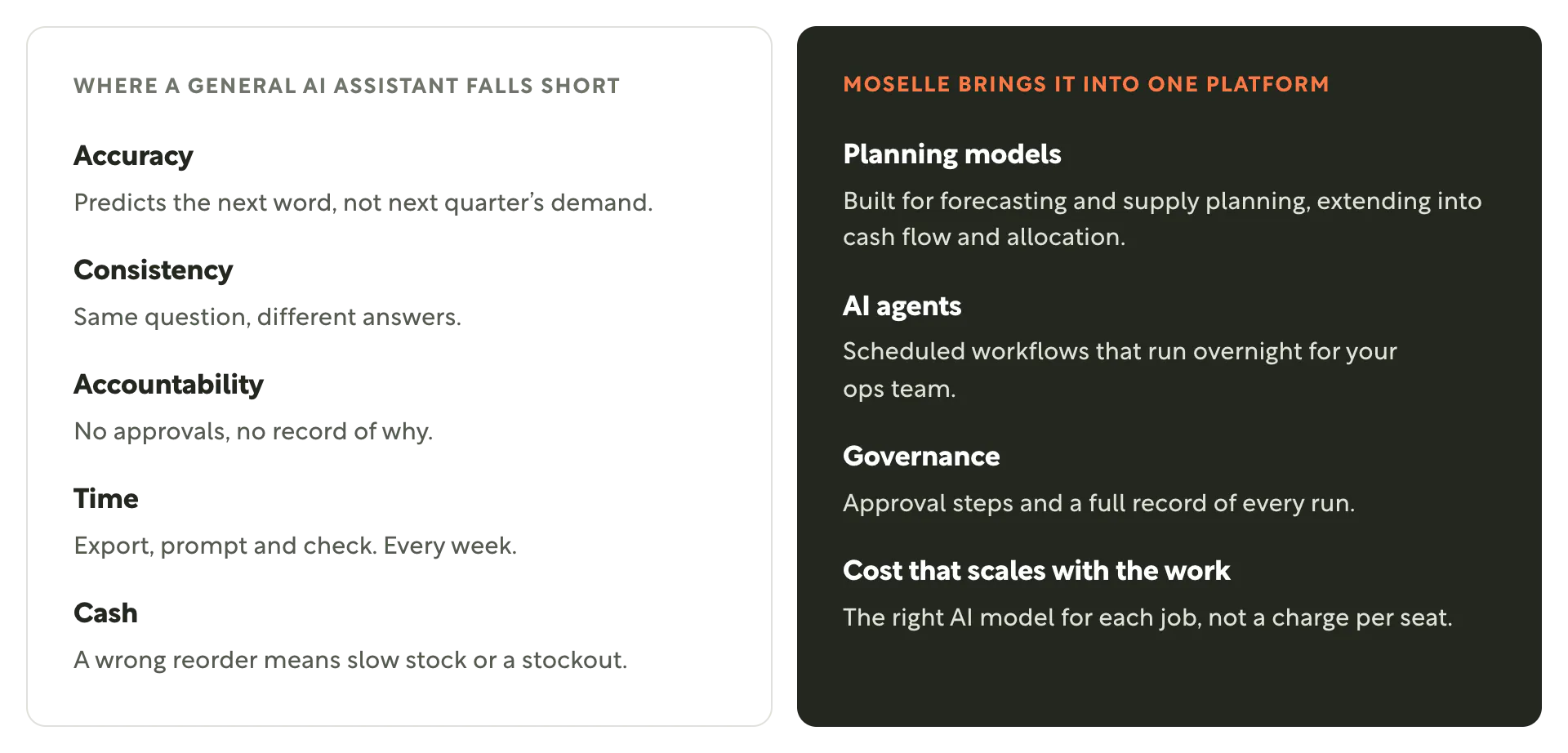
Can ChatGPT or Claude forecast inventory demand?
Start with Moselle's AI agents. Mo can analyse your data, explain a projection, draft forecast edits and build recurring workflows. It's like giving your ops team an analyst who never logs off.
So can ChatGPT or Claude forecast your demand? They can produce a forecast, but it won't be one you can plan on. They only see the export you paste in, which is often incomplete, out of date or inconsistent across channels. And they don't run forecasting models on your sales history; they reason their way to a best guess that looks confident and can change every time you ask.
Moselle forecasts from up-to-date data synced from your sales channels, using a library of models trained on your own sales history. Mo chooses the plan that best fits your business, and if you want to review and compare, you can look through every model yourself:
- Statistical models such as Athens, Rome and Berlin, tuned for trend and repeating seasonality.
- Probabilistic models such as Venice and Hong Kong, built for seasonality and demand spikes.
- Deep learning and foundation models such as London and Tokyo. Tokyo is fine-tuned on your own sales history.
- Revenue allocation models, Bombay and New York, which turn a revenue goal into units across your SKUs using your pricing.
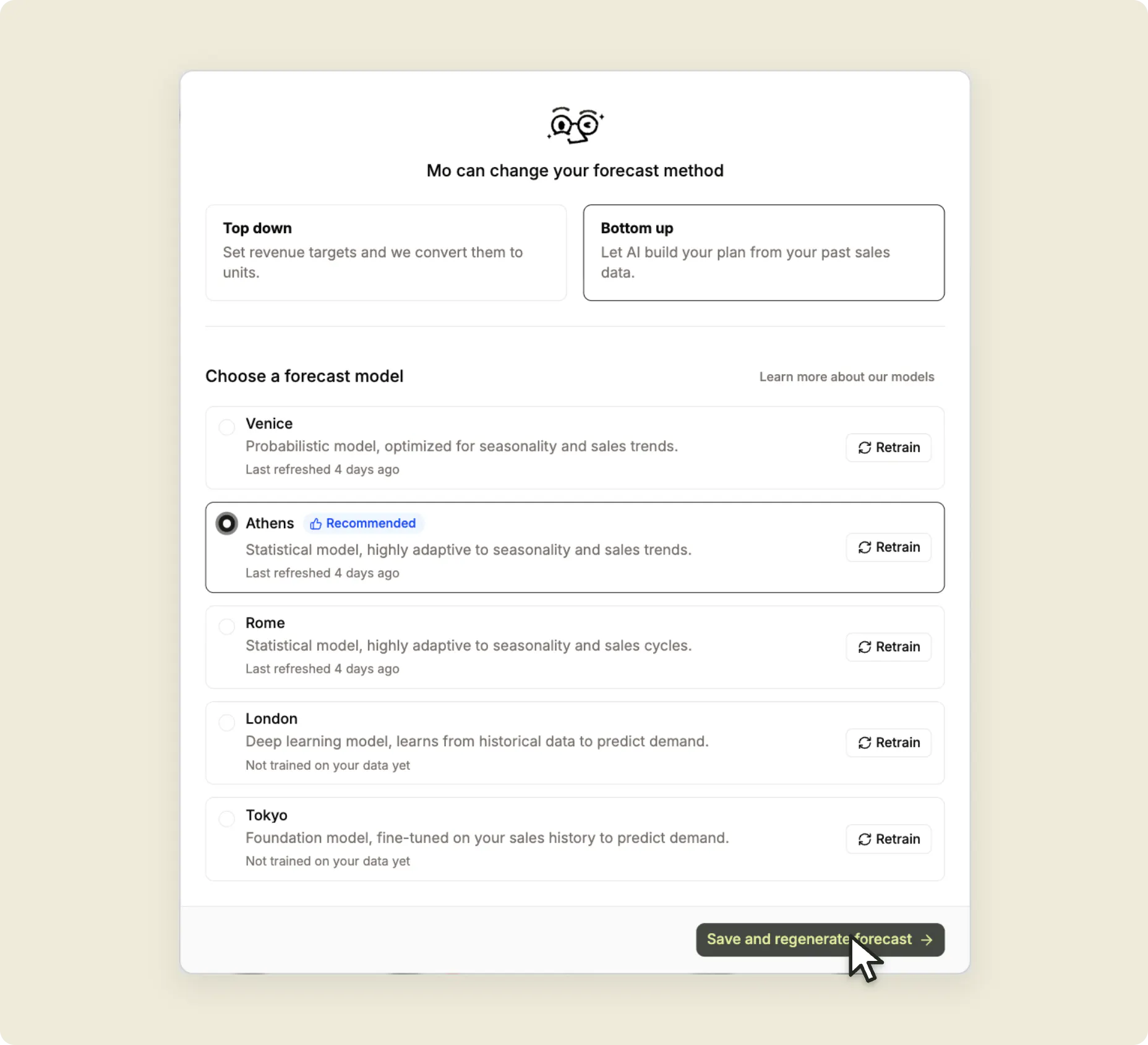
Those forecasts flow straight into your supply and production plans, so suggested orders are tied to the forecast you approved. When generating production orders, you choose what to optimize for: Cost (cash flow and unit costs) or Lead time.
One approved forecast drives every plan that follows: supply, production and revenue allocation today, with cash flow and stock allocation planning built on the same foundation.
Why it matters: You get the reasoning power of AI and the accuracy of models built for demand, not one pretending to be the other.
How does Moselle keep AI planning secure and governed?
Moselle treats your planning data as mission-critical. Each company's data is kept separate, every request is checked against who is asking and what they're allowed to see, and connections to your sales channels and AI tools use secure sign-in you can revoke at any time.
Personal data and credentials are kept out of the copies our own team works from. A general chat assistant offers none of this for your planning process; its only record is a chat history.
Moselle's AI workflows build on that foundation, so automation never means losing control:
- Agents follow the same rules as people. Agents work through Moselle's own access controls, so every run uses the access of the person who owns it.
- Decision and approval steps. A workflow can pause at an approve step before it edits a forecast or a supply plan. Moselle emails the owner, shows exactly what will change, and nothing moves until someone in your team approves it.
- Owner control. Everyone can see every workflow and its runs, but only the owner can change its schedule, steps or recipients.
- A full record. Every run is saved with its steps, so you can see what ran, when, and what it changed. The Monitor tab tracks hours saved, decisions made and money at stake.
- Self-repair with a human in the loop. If a step breaks, Mo proposes a fix and the owner approves it before the workflow carries on.
Why it matters: AI does the work; your team keeps the final say. Every change is traceable.
Why do AI agents cost less than prompting all day?
A chat assistant only works while someone is typing, so its real cost is your team's time plus an AI seat per person. Moselle's agents run scheduled workflows on their own, often overnight, and use the right-sized AI model for each job. Your team starts the day with results, not prompts.
- Scheduled workflows run on their own, daily, weekly or when new data lands, and are ready before your team logs on.
- Saved steps, not saved prompts. Each workflow's steps are saved as code and re-run exactly, so the numbers match run to run.
- The right model for each job. Moselle uses frontier models where deep reasoning pays off and lighter, faster models for routine tasks, scaling up and down with the work.
- Results delivered. Workflows email a summary and spreadsheet to the owner or the whole company.
Why it matters: You pay for outcomes delivered overnight, not hours of prompting.
What is the Moselle MCP server?
The Moselle MCP server lets AI assistants such as Claude connect securely to your Moselle account. MCP (Model Context Protocol) is the open standard AI tools use to plug into business software. Once connected, your assistant can see your Moselle workflows, their run history and the data tables they save.
- Sign in with Moselle. You approve exactly what the tool can see on a consent screen, and you can disconnect it at any time.
- See your workflows. Ask your AI tool which workflows ran, how they went and what they found.
- Read your workflow data. Pull the tables your workflows save straight into the conversation.
Your team may already connect sales, marketing and finance tools to their AI assistant. Now inventory planning sits alongside them, tracked the same way as every other channel.
AI assistant vs. AI planning platform
ChatGPT and Claude can give you an answer. Mo gives you a plan you can run your supply chain on. Here’s how they compare.
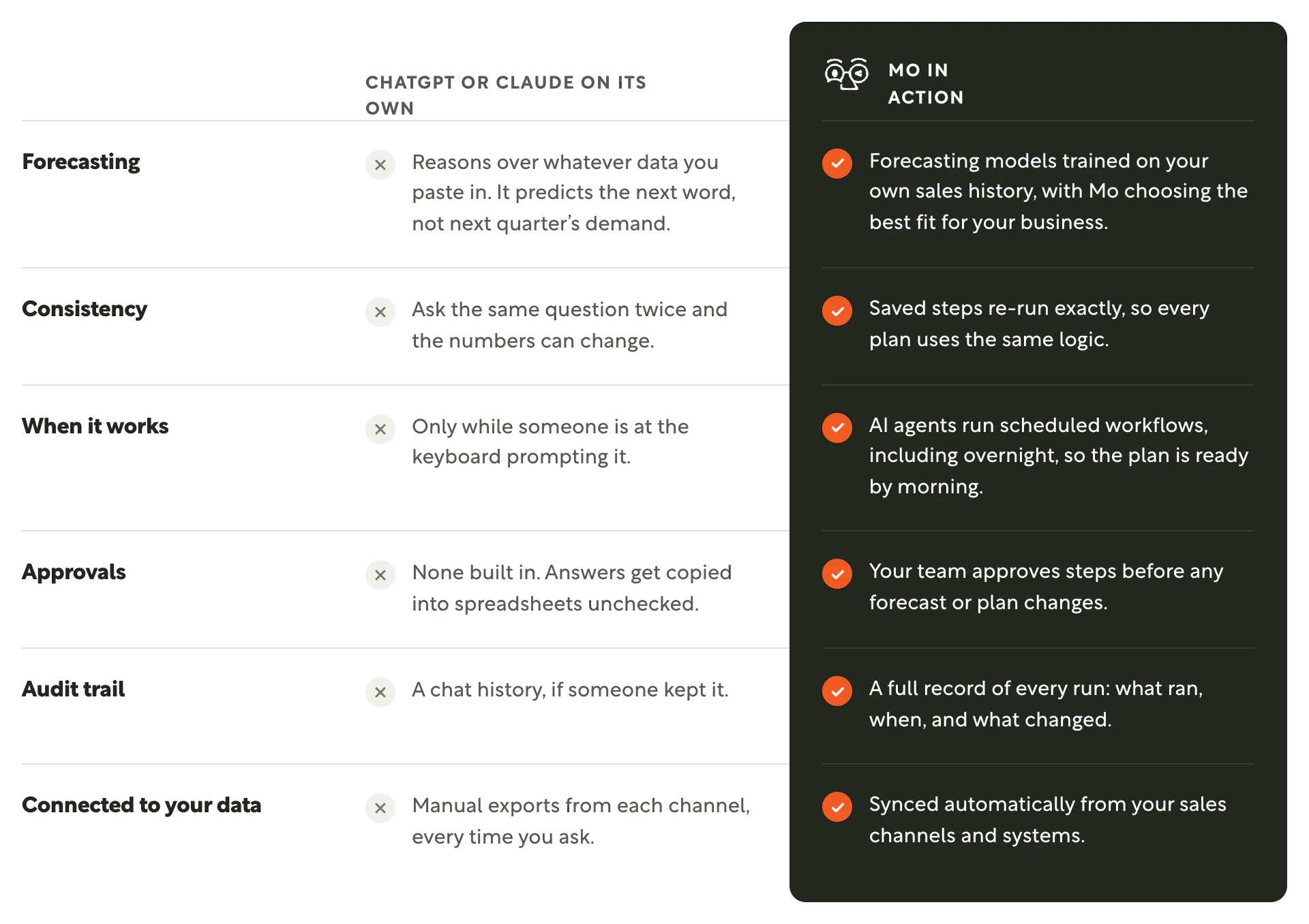
A simple test: If a wrong answer would change what you order, it belongs in Moselle.
Ready to see it?
- Have more questions? Book a demo and see how Mo workflows run on your own data.
- Already a customer? Open Workflows in Moselle and ask Mo to set up your first one, or connect the Moselle MCP to Claude.